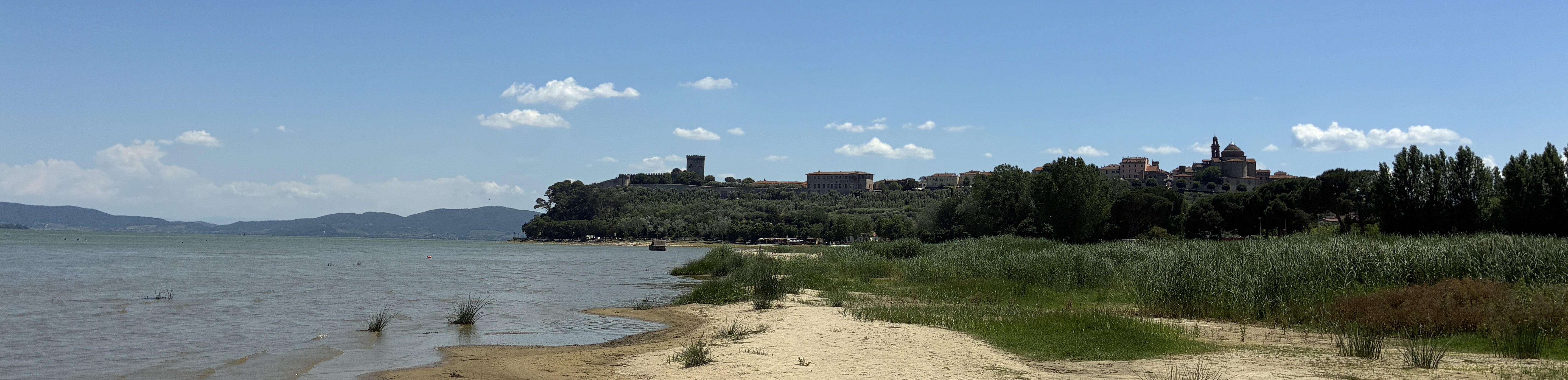
A visitor to the town of Castiglione del Lago and its territory sees the area as it is now: a town sitting on a hill, overlooking Lago Trasimeno to the east and the plains to the west. This territory is an important resource for fishing, agriculture, recreation, and tourism. What might be more difficult for a visitor to see is the geologic and cultural transformations that this landscape has gone through to get to this point. These pages explore this past to show how the current picture of Castiglione del Lago was shaped by its past.
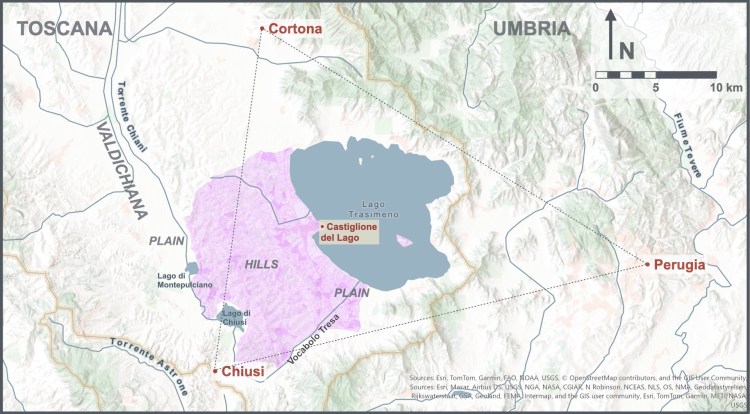
The territory of Lago Trasimeno is located between the Apennines to the east and the Valdichianna to the west. This area is located almost entirely inside of the province of Umbria, and since antiquity the cities of Perugia, Chiusi, and Cortona have extended their influence over the lake. The TRAP team’s research has focused on the western side of Trasimeno in the territory of Castiglione del Lago, which extends from the lake, across the Tresa plain to the low hills bordering the Valdichiana.
The earliest human activity in the region dates to the Middle Palaeolithic period, ca. 120,000 B.P. From the Neolithic period, ca. 5900-3600 BC, there is archaeological evidence for a settlement at Panicarola-La Lucciola. That site was reoccupied in the Bronze Age based on the necropolis that has been excavated there.
The Villanovan period in the Early Iron Age, ca. 1000-725 BC, marks the beginning of Etruscan activity in the region. To date, the primary evidence for the Etruscans in Trasimeno comes from necropoleis and chamber tombs, mostly located along the ridge between the Tresa plain and the Valdichiana. The TRAP team is particularly interested in investigating Etruscan settlement in the region and the possible presence of Etruscan sanctuaries.
In the early 2nd century BC, the Roman conquest of Umbria brought the Etruscan period to an end. In subsequent centuries we see a reconfiguration of the landscape with Roman agricultural villas controlling large areas, especially in the Tresa plain. However, there is now evidence of at least one Imperial period luxury villa at Gioiella and a Roman water sanctuary on the slope of Castiglione del Lago.
Follow the links below to learn more about the history of the territory.

